As and when I have time, this
page will be added to, providing an insight into what I'm
getting up to in the mountains.
A
week of pretty good weather and excellant autumn conditions.
Stags roaring and changing colours. No snow yet, but it's
early days.
A
great week of walking programmes with Walklochaber
This is a new company started up in the area and aims to offer
mountain walking routes. No ropes at all, just plenty of good
hill walking, summer and winter.
A short trip out blighted by losing my baggage
between Luton and Geneva on the first day! Fortunately the
team of clients were experienced and able enough to climb
the Lagginhorn without me, whilst I retrieved my kit, even
if they did lead some people astray towards the Fletschhorn
in the early morning mist, before regaining the correct route!!
We
had planned to try the Matterhorn, but unfortunately a big
dump of snow since my last visit had put paid to that idea.
The Matterhorn needs to be dry and reasonably warm for a successful
attempt.
When the rocky ridges are plastered it is better
to visit snowy peaks and with that in mind visitors to Zermatt
have plenty of options on the skyline running east from the
Klein Matterhorn cableway.
We traversed over Castor and spent two nights
in the Quintino Sella Hut, with a view to trying Liskamm.
The only problem was the strength of the wind and along with
a number of other parties we turned back to the hut in the
face of bitterly cold WNW gusts.
The following day we retraced our steps back
over Castor and ascended the SE Ridge of Pollux before descending
to the Ayas Hut for the night. This hut is certainly worth
a visit, being very comfortable and with friendly hosts.
The
final day started very well and the plan was to traverse the
half Breithorn, which includes the interesting rocky towers
towards the western end. Access to this was made via the Cesare
e Giorgio Rossi Bivouac and the high glacial shelf beneath
the crest. The Breithorn is a mountain of great variety, with
the easiest approach of any 4000m peak, plus some very taxing
passages on the traverse and a number of much harder routes
on the north face.
Unfortunately for us the weather lived up to
its forecast very quickly. A bright starry, early morning
sky quickly lowered and our chosen route changed to a very
brief ascent of the main summit from the col to its west.
By the time we arrived back at the cable car terminus it was
a full-on blizzard. Just going to show how it is usually better
to listen to the weather forecast and reduce your plans to
suit.
A
good start to the 2006 alpine season, although the snow is
pretty soft as the freezing level is high and glaciers very
soft. It's better to go for west facing early morning approaches
to rocky ridges, which stay in the shade longer. I have recently
climbed Allalinhorm, Hohlaubgrat with an approach from the
Hohlaub Mittell Station on the Metro Alpine. This can be achieved
with an early start from the valley, although we did spend
a night in the Britannia Hut above Saas Fee for acclimatisation
purposes. After that I went to the Mountet Hut above Zinal
and traversed the Zinal Rothorn via the North Ridge and descent
to the Rothorn Hut and Zermatt. The descent took ages in the
soft east-facing snow fields.
The
photo opposite is on the Bosse of the N Ridge of the Zinal
Rothorn, which is currently in very good condition.The rock
on the North Ridge is very good. I would recommend descending
this route back to the Mountet Hut as the snow conditions
on the Zermatt side are very poor. Also the descent couloir
has plenty of loose rock. It is possible to avoid most of
this, by abseil on the right bank in descent. A traverse across
the fall-line of the couloir must be made at some stage. The
final traverse to the 'Schneegrat' and safe ground often requires
crampons as black ice beneath the snow is very unpleasant
and the ground below is 'terminal'.
The same group from the Zinal Rothorn also climbed
the Hornli Ridge on the Matterhorn a couple of days later.
This was in very good shape with snow only at the 'shoulder'
fixed-ropes. No need for ice axe, but make sure your crampons
are packed. We were also fortunate to arrive on a quiet day
with few queues and no hassle. The ascent time will be reflected
in descent and we had a twelve hour day. This often involves
another night, either at the Hornli Hut, or better still at
Schwarzee Hotel. Showers, clean sheets, good food and a two
minute trek to the cable car the next morning.
Unfortunately
a rockfall led to the untimely death of two climbers near
the new section of lower fixed-ropes. Below these ropes the
way is not entirely clear and being off-route on the Matterhorn
can quickly lead to loose rock. This section is only thirty
minutes to the hut. Loose rock in the Alps is becoming even
worse than in the past, due to the deep-ice melting away and
lessening the cementing properties which snow and ice can
provide. Always look carefully for the waymarking signs of
crampon-scratched rocks and treat all rock as if it is going
to come loose in the hand. Moss and lichen-covered rock often
show you are off route, especially on popular climbs.
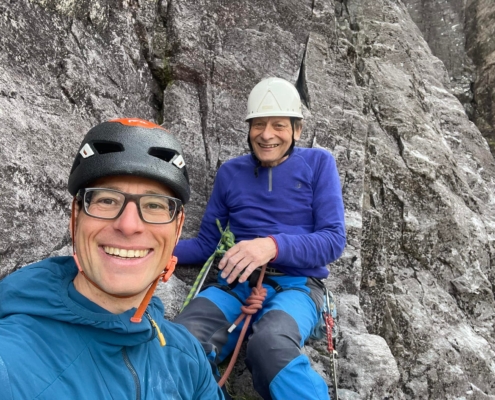
Mike
and Gerry, shown with me on right have been trying to climb
the Matterhorn for ten years. This photo from Gerry's camera
is taken by fellow guide John Lyall on the summit. Waiting
so long just goes to prove that this mountain is no simple
ascent. The conditions need to be right, both with the mountain
and the climber. Three years ago we were all set for the summit
and a large section fell off. This resulted in the route being
'closed for repairs' by the Zermatt guides. Over many years,
too much snow on the route has thwarted our enthusiasm. Mike
and Gerry had to wait for another few years. Well done guys!
You have to go with an open mind for the Matterhorn
or alternative climbs with a British Guide if conditions halt
an attempt. Another possibility is to hire a local guide if
the conditions come good and you have acclimatized yourself,
without a guide beforehand. This can save money if the weather
is poor. Ideal places for acclimatizing at high huts and simple
4000 metre peaks are off of the Saastal, at such huts as Almageller-Hohsaas-Weissmies.
Try
to spend time sleeping at altitude. Day visits are not so
beneficial as spending nights high, up to 3000 metres with
climbing to a higher altitude. Acclimatisation is a very personal
affair and individuals respond in a variety of ways. Also,
make sure you arrive fit and well to enhance your chances
of success. On our recent successful Matterhorn ascent we
were in company with a 67 year old guide, Thomas Huber. So
there is hope for all of us yet!
Today (23rd July) I am resting down in Zermatt before another attempt over
the next three days. R&R come high on my list of essentials
for success in the mountains.
Check out Hotel Cima Garni, B&B twin room is CHF 65.
Run by A. Perren, it is quiet and close to the station. Telephone
0041 (0)27 967 23 37. Mr Perren speaks good English and is
very helpful. Storage for gear whilst away climbing is also
available. I normally use Hotel Bahnhof, Tel: 0041 (0)27 9672406
Family Biner. They provide bed only and self-cater in modern
kitchens, but were full this time.
Zermatt does have some little bars with free wireless connection,
allowing me to upload details on to this site with my trusty
HP laptop. One such place is 'Potters Bar', which also has
Sky TV for watching the football! Also, the balcony at Hotel
Post is a great little spot to eat, drink and make use of
their free wireless connection as the world strolls by below..
For
those of you who prefer more peace and quiet than can be offered
in Zermatt and also the chance to drive into a good campsite,
look no further than 'Camping Mischabel'. I have used this
campsite most years since 1990 and can vouch for the friendly,
good service provided by Grit Lauwens, ably assisted by her
husband Ludo and occasionally (?) their son Hans. These folk
are from Belgium, although they have adopted Saastal as a
second home and run the campsite for the owners during the
busy summer months.
The camping is only a short walk from the village and food
stores and the legendary Hotel Roby 'mixed grill'. No place
for vegetarians here I'm afraid!
I
see a note on your website regarding an Elephant at the top
of Mitre ridge on Bheinn a Bhuird. (note dated 24 April)
I came across it last thursday (see attached snap) and am
naturally intrigued. It appears to be made of fibreglass,
and is of such a weight it is unlikely to have been 'carried
in'.
Is any further information available from your sources? All
info gratefully received!
Regards
Paddy Heron
Dinnet, Aboyne,
Deeside
Playing
away this weekend at the British Mountain Guides 'Open Day'
to introduce the scheme to a wide range of climbers. It was
a very successful day out on the Saturday and on the Sunday
many folk went out climbing in small informal groups. On the
Saturday, after some indoor chat we all went to White Ghyll,
Langdale. Sorry if we rather took over the crag folks, especially
the guy who felt I was being rather "noisy"! Sunday
was another good day out on Castle Rocks, Thirlmere, with
some adventures avoiding the Geese guardians!


Disaster
has struck West Coast Outdoor Leisure in Fort William. In
the early hours of the morning a fire which started next door,
swept through the shop owned by Dave Wrigglesworth. As many
of you will know this to be one of the best independent climbing
shops in the UK and I'm sure you will join me in wishing Dave
Wrigglesworth and his smashing staff all of our support for
the future. Check out West
Coast Leisure News
Just arrived home from a wonderful trip to New
Zealand, where I was successful with an old friend (Bruce
Davies) from Loch Eil Centre in climbing Mt Cook.
Don't
underestimate Mt Cook. Our route up and down the Linda Shelf
was a full 18 hours return trip from Plateau Hut. The fastest
guided group on that day took 15 hours and others regularly
take over 20 hours. The Linda Glacier faces east and north
so gets all the sun going from early on. Snow shoes were being
used by a number of guided parties. The whole route is threatened
by seracs and has complicated crevasses. The upper rock ridge
is loose and you need to abseil in descent for about ten pitches
(fixed) if you only carry a 50 metre rope. Take some snow
stakes and ice screws which you would be happy to leave behind
as the last abseil is longer than 25 metres over a schrund.
You do not need much rock gear, maybe a selection of six nuts
(small to medium) and some slings and extensions. Take a helmet
and two axes, one at least should be a technical spec axe.
Thanks to Bruce for my summit photo.
We
flew with Mt Cook Ski Planes Mt
Cook Ski Planes in a fixed wing to Plateau Hut 2000metres.
Check in with the DOC (Dept of Conservation) in Mt Cook Village
before you fly. We paid $30 NZ per person night in the hut.
You must take sleeping bags and all cooking stuff apart from
the stove which is provided at the hut. We carried a small
gas stove on the route for melting water as 18 hours is a
long time for rehydrating with a two litre bottle. A lot of
people fly in and walk out, but we used a plane both ways!
Mt
Cook Village is no good for food shops so we stayed an hour
away in Twizel in a good Backpackers. Mt Cook Village does
have accommodation from tents to expensive hotels. The local
guides are worth a visit to check out conditions. We were
very fortunate to have a two week slot of good weather, but
that is unusual. The nearest international airport in Christchurch
is four hour drive away. Car rental is cheap and we used Quality
Car Rental
Apart
from all that, take as long a holiday as you can afford, as
NZ is the best country in the world you will ever visit, including
Canada BC, Scotland et al. Beaches to die for and only 4million
people, 3million of whom live in the N Island. 70 million
Possums that eat around 20k tons of vegetation a night! Check
it out.
this year are being run
with the help of Chris Ensoll, John Lyall, Jonny Baird and
Eric Pirie as I am staying home in Scotland before a holiday
trip to New Zealand later this year. The weather was fairly
unsettled at the start of July as can be seen by the amount
of snow on the Nadelhorn above Saas Fee in this photo kindly
donated by Joe.
for a change
has produced some varied weather, but in between the showers,
plenty of good climbing from Glen Coe to the Isle of Skye.
One of the enjoyable features about spending time in Scotland
is the really different rock types and splendid variety of
locations. Plenty of good views interspersed with sea and
loch vistas. Also there is no worry about receding glaciers,
rockfall or early hut starts. The midges can be a nuisance,
but plenty of 'Skin so Soft' and you not only smell nice,
but avoid being eaten alive! The couple in the picture opposite
were from Sicily and by all accounts that looks like a place
worth heading for with a cheap Ryanair flight. Plenty of warm
rock and good wine and pasta. Definitely a good early winter
destination for next year.
As always the Isle of Skye has been popular, although many
of the traverse attempts were thwarted by poor weather. I
find that people often over estimate their ability when it
comes to the Black Cuillin. It has a unique place in the British
mountain pecking order and is far ahead of anything in England
or Wales. So, you may have scrambled briefly over Striding
Edge or the Snowdon Horseshoe or even the Aonach Eagach in
Glen Coe. These short outings are really only for starters
if you are considering a trip to Skye. My recommendation would
be to spend a few days on the ridge and come down each night
to a comfortable bed. In this way you can get a feel for the
nature of the ground and be better prepared if you still feel
a traverse attempt is for you. A confident approach to exposed
and often loose mixed scrambling is essential.
Ledge
Route on Ben Nevis is a good training route for Skye, but
make sure you have ascended a route such as Tower Ridge and
descend the Ledge Route. Also, when climbing Tower Ridge,
bear in mind that around twenty ascents of Tower Ridge is
equivalent to doing the full Black Cuillin Traverse.
Good luck
had a good build-up of snow and stayed in good condition throughout
the season. The rocky ridges suffered, especially the Matterhorn
which had snow on the Hornli ridge throughout the period,
making it less of an option as it relies on drier conditions
to be in good nick.
The season for me started in late June in Chamonix.
The Aig du Midi cable car was not working as the cable had
been dropped on the main road by mistake! Access to the big
summits of the Vallee Blanche was by the tunnel and La Palud
to the Torino Hut. A successful day on the Rochefort Arete
was followed by an attempt on Mt Blanc. We were going very
well but had to turn back 200m from the summit in a white-out.
The
second week in July looked like it could be plagued by poor
weather after a very cold and windy ascent of the Fletschhorn
above Saas Grund, but a move to the southern side of the Monte
Rosa group and access to the Gnifetti hut from Alagna Valsesia
proved successful. We had one fairly 'Scottish' day on Piramide
Vincent and Ludwigshohe followed by a glorious ascent of Parrotspitze
to the Margherita Hut for lunch the next day. A planned attempt
on Liskamm was cancelled due to poor weather. Another traverse
of the Rochefort Arete later in the week rounded off a good
programme for returning clients.
During
the last two weeks of July the weather became mostly settled.
One trip over Liskamm and Monte Rosa was unfortunately cut
short due to lack of space in huts which normally have spare
beds. Alternative ascents of the Allalinhorn-Hohlaubgrat from
the Britannia Hut and a visit to the Grand Paradiso plus two
traverses of Mt Blanc rounded off the month.
A personal holiday for the first two weeks of
August with visits to Mt Velan and Monte Viso, plus a visit
to Monte Carlo to 'oggle' at the fabulous yachts with the
odd Ferrari parked on shore.
We traveled back up through the Ecrins to Chamonix for another
four weeks of generally good guiding weather. Further ascents
of the popular Rochefort Arete by some folk who had previously
been intimidated by the idea, but were pleasantly surprised
and gained in their alpine confidence afterwards. As the season
progressed the approach to the arete changed from good snow
to loose rocks. This route certainly is a better proposition
with more snow on it. Not only does this cement the rocks
in place but also enhances the quality of the ridge itself.
Later in the season the approach slopes can be unstable and
the arete itself very icy.
During
the last two weeks of August we visited the superb Almageller
Hut and climbed on the Dri Hornli and Portengrat, two of my
top ten routes in the Swiss Alps. Perfect rock and great weather
most of the time. Unfortunately a short spell of poor cold
weather put down a blanket of snow on the Matterhorn, which
stopped us attempting that peak again. It really only came
back into good shape towards the second week of September.
One of my clients made a successful ascent of the Matterhorn
with a Zermatt guide after ten days on the trot with me in
continuously perfect late summer weather. We rounded off my
summer guiding season with ascents of Portjengrat, Nadelgrat,
Allalinhorn, Castor, Liskamm, Corno Nero, Ludwigshohe, Parrotspitze,
Signalkuppe, Zumsteinspitze and Dufourspitze.
All in all a great summer. Next year a similar programme
will be on offer from mid-June to mid-September, so book early
to avoid being disappointed. |